
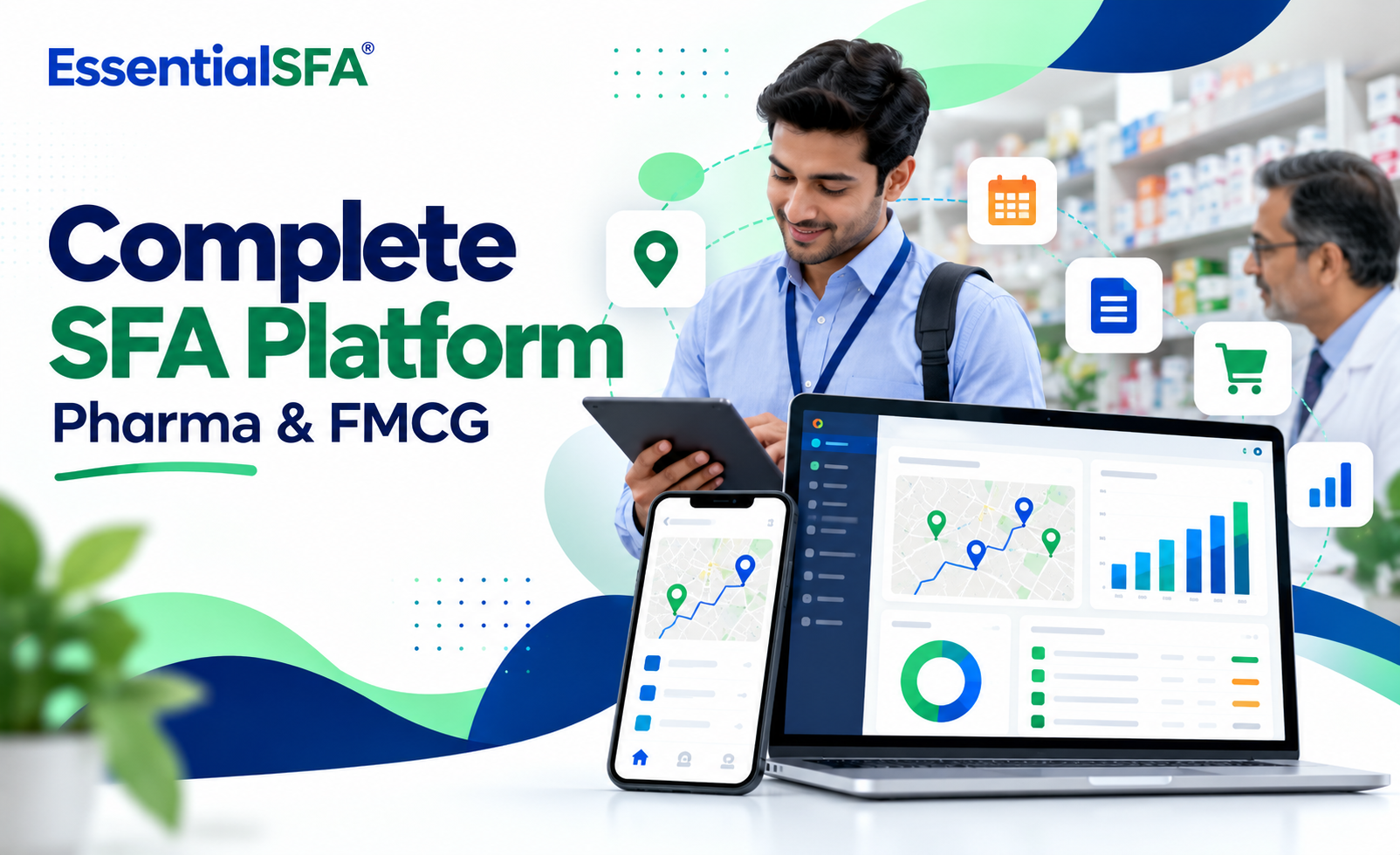
What A Complete SFA Platform For Pharma And FMCG Includes
A complete SFA platform pharma FMCG teams will actually adopt has to start from the day of a front-line rep. From morning start to closing calls, everything should sit in one app with one login, not four different tools.
For Indian usage, that usually means an all in one SFA platform India setup with offline support, multiple languages, and low-data modes for weak network areas. It also needs admin and manager views that make sense for regional hierarchies and distributor-driven sales.
Core Daily-Use Modules
The first bucket is what your reps touch every day. If these are weak, nothing else matters, no matter how fancy the analytics deck looks in demos.
Manager And HO Controls
The second bucket is what managers and HO teams use to control, guide, and improve the field force. This is where a unified field force sales platform really pays off.
You should expect territory mapping, dynamic patch re-allocation, daily call coverage monitors, and exception alerts. Without this layer, your data turns into weekly PDFs that nobody acts on, instead of live dashboards guiding coaching and micro-campaigns.
Territory, Beat, And Customer Master Management
Most implementations fail not because the app is bad, but because masters are a mess. Territory, beat, and account master management must be built into the SFA workflow rather than sitting in a separate MIS tool.
In a complete stack, HO should be able to push structured masters to the field, lock critical fields, and still let reps suggest edits and new HCPs or outlets from the app. That mix keeps data clean without becoming a bottleneck.
What Good Master Data Handling Looks Like
At scale, you want clear rules: who can add a new doctor, who approves outlet downgrades, and which fields are mandatory. A good system also supports chain stores, hospitals, institutions, and key accounts without workarounds.
Once visits are in control, orders and visibility come next. For FMCG especially, a complete SFA must tie orders, merchandising, and schemes into one screen so the rep is not guessing what to pitch.
A strong merchandising layer will support photo capture with planogram references, outlet scores, and simple surveys. Those photos must be easy for managers to review, filter, and use in coaching, not just sit as storage-heavy thumbnails.
Channel And Trade Programme Handling
Pharma has its own complexity with stockists and sub-stockists, but FMCG trade schemes are a different beast. Your SFA should show applicable schemes, slabs, and balance on the order screen so the rep can negotiate with confidence.
Many teams now look for an sfa software full feature checklist that explicitly covers claim approvals, promo code handling, and scheme-wise off-take tracking. If it is missing, you will end up rebuilding these parts in spreadsheets around the tool.
Analytics, Compliance, And HR Integrations
Data is where pharma and FMCG SFA projects win or fail. If the platform cannot convert daily activity into simple, trusted views, adoption drops and your investment quietly goes to waste.
For a mid-to-large Indian company, the baseline is clear: daily territory coverage, call averages, new HCP/outlet additions, order value distribution, and expense trends. More advanced teams want brand focus dashboards and cohort analysis by doctor or outlet segment.
What A Unified View Should Deliver
A unified field force sales platform should allow sales, marketing, HR, and finance to look at the same underlying data with different filters. That means a single master for people, geography, and accounts, with role-based access instead of four different databases.
Systems like EssentialSFA also tend to connect with payroll and incentive engines so HR is not manually reconciling eligibility every cycle. When this part is done well, you can cut two to three days of manual incentive work per month for each region.
Adoption, Offline Use, And Change Management
The part vendors underplay is adoption. In pharma and FMCG, you deal with large, diverse field forces. If the app is slow, confusing, or heavy on typing, adoption will quietly slide after the first three months.
Offline use matters more in India than glossy UI. Reps need to complete calls, capture orders, and queue data without a live network, then sync when possible. A complete SFA platform pharma FMCG stack that ignores this will only work in metros.
Practical Ways To Drive Adoption
There are a few patterns that work repeatedly in successful rollouts, regardless of brand or region size. They are not fancy, but they are reliable.
Pilot with real skeptics: Include tough, senior reps in pilots, not only tech-friendly early adopters.
Cut duplicate work: Remove old Excel and paper reports the same week SFA goes live to signal seriousness.
Give visible wins: Show managers faster beat approvals and cleaner incentive calculations within the first month.
Train in the field: Pair classroom training with on-route support for the first few weeks of go-live.
Close feedback loops: Act visibly on field feedback in product updates so reps feel heard.
How To Evaluate Vendors In The Indian Context
Once you know what a complete stack should include, the hard part is separating slideware from reality. Most demos look similar; the gaps appear during implementation and scale-up.
Start with reference checks: talk to Indian pharma or FMCG teams using the tool for at least a year, in your field-force size band. Ask pointed questions about downtime, support responsiveness, and how often they still fall back to manual work.
Questions For Your Shortlist
There are a few blunt questions that quickly reveal whether a vendor has built a real all in one SFA platform India players can run for years, or a stitched-together stack that will fray under pressure.
- Implementation model: Who configures masters, hierarchies, and incentives, and how are changes handled after go-live?
- Release cadence: How often are updates shipped, and how is regression tested before pushing to thousands of devices?
- Support structure: Is there India-time support with pharma or FMCG context, not generic IT helpdesk scripts?
- Scalability proof: What is the largest active field force running on the platform without performance issues?
If a vendor cannot answer these clearly, your risk is not just licence cost; it is one to two lost years of field productivity while you re-implement with someone else.
Conclusion
A complete SFA platform pharma FMCG businesses can trust in India covers four big areas: daily rep workflow, masters and beats, orders and trade, and unified analytics. Anything less will push your teams back into manual patches within months.
When you evaluate options like EssentialSFA, focus less on slideware modules and more on how they work together in your exact structure. Start with a clear checklist, push vendors hard on implementation details, and choose the partner that can support change for the next five years.
Frequently Asked Questions
Q1. What Is Meant By A Complete SFA Platform For Pharma And FMCG? Ans: A complete SFA platform for pharma and FMCG covers the full field workflow, from attendance and beat plans to orders, expenses, trade schemes, and analytics. It removes parallel spreadsheets and WhatsApp reporting so managers and HO see one consistent version of activity.
Q2. How Does A Complete SFA Platform Pharma FMCG Stack Help Managers? Ans: It gives managers live visibility into coverage, call quality, and order status across territories. Instead of weekly summaries, they can see who is off-plan, which brands lack focus, and which outlets or doctors need visits, then coach or intervene the same day.
Q3. What Should I Look For In An All In One SFA Platform India Vendors Offer? Ans: Prioritise offline capability, clean masters, geo-verified visits, trade scheme handling, and simple DCR flows. Confirm that support, training, and configuration teams are India-based and experienced in pharma or FMCG rollouts, not just generic enterprise software projects.
Q4. How Long Does It Usually Take To Implement An SFA System? Ans: For a mid-sized field force, serious implementations usually run two to four months from contract to full rollout. Timelines depend heavily on master-data readiness, clarity on territories and hierarchies, and how quickly pilot feedback is incorporated into the final configuration.
Q5. Can SFA Software Handle Incentives And Expense Approvals Too? Ans: Many modern SFA tools integrate incentives and expense workflows so performance data, eligibility rules, and claims sit in one place. HR and finance teams then spend less time reconciling reports and more time refining schemes that reward the behaviours the business wants.